Getting Started With Laravel 4, Chapter 4: Authentication and Security
Authenticating users
PHP doesn't have any way to authenticate users. This leads to many problems, and many different solutions in pure PHP. Laravel provides the tools to make this happen.Creating the user model
Laravel provides default inside auth.php and an existing user model that we can take advantage of. For this app, we will simplify it a little bit.Creating the users database schema
The author introduces a foreign key constraint. And we will use a seeder function to add data to our new user table. We are also introduced to the Hash::make helper. Laravel expects all passwords to be hashed with this function. You should not store passwords in clear text, and you should not hash them with some of the weaker algorithms (md5 or sha1).Authentication routes and views
We make a few changes to our master view to accommodate users, allowing them to login and logout. We pass in our username and password to the Auth::attempt method. When this function returns True, we can redirect them to where they wanted to go, or we can redirect them to where we want them go. If it returns false, we redirect them to login page. Inside app/filters.php There is a guest() method. You can use this to redirect the user to the correct page by changing these filters. We also create a simple login page for the cats app. We also need to create a logout route. The next step is to wrap all of our protected routes inside an auth route group. Finally, we add a few lines of code to all of our views to protect them from unauthorized users. We also need to add the user_id to our function that saves a cat.Validating user input
You could use regular expressions to validate data, but Laravel makes this so much easier. There are over 30 different validation rules. Too many to go over in this section. Make sure you read the documentation. You can check if the validation fails, collect the errors, and then display them back to the user by redirecting back to the form page.Links:
https://laravel.com/docs/5.6/validation
Securing your app
Before deploying our app, we need to see what Laravel can and can't do to protect us and our users.Cross-site request forgery
Form:open/Form:model already add CSRF tokens to to help prevent these attacks. To take advantage of these will we wrap our routes inside a Route::group. It will make sure these routes check the hidden CSRF token before allowing the request to come througLinks:
https://en.wikipedia.org/wiki/Cross-site_request_forgery
Escaping content to prevent cross-site scripting
XSS is when a bad user inserts code into our database. Never trust input from users. To protect us against such attacks we user {{{}}} (triple curly braces). This will not allow the code to run on our site, instead it will "escape" all the text, and just display it on the screen.Links:
https://en.wikipedia.org/wiki/Cross-site_scripting
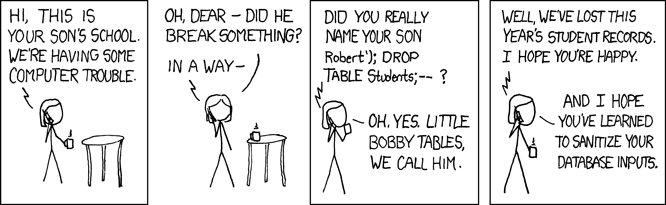
Avoiding SQL injection
Laravel protects against this by default. Eloquent uses PDO behind the scenes. The trouble we can run into is when we choose to write our own sql queries using DB::raw. To protect against this, we will replace any variables in our sql with a question mark, and pass in an array of those variables.No mention of sql injection is complete without mention of Little Bobby Droptables from Randall Munroe over at XKCD.
Links:
https://en.wikipedia.org/wiki/SQL_injection
Comments
Post a Comment